The moment you first pick up a guitar, a journey begins – one filled with melodies, practice, and the occasional need for maintenance. For acoustic guitarists, few tasks are as fundamental, yet often daunting, as changing strings. But what if you could transform this chore into a quick, satisfying ritual, enhancing your guitar’s voice and extending its life? Imagine the crisp, vibrant tone of fresh strings under your fingertips, bringing new life to every chord and riff. This comprehensive guide will demystify the process, equipping you with the knowledge and techniques to change your acoustic guitar strings swiftly and correctly, all from the comfort of your home.
Why Changing Your Acoustic Guitar Strings Matters
Over time, acoustic guitar strings inevitably lose their brilliance and playability. Finger oils, sweat, dirt, and constant tension cause corrosion and metal fatigue, leading to a dull, lifeless tone, poor intonation, and even breakage. Fresh strings aren’t just about preventing snaps; they dramatically improve your guitar’s sound clarity, resonance, and tuning stability, making playing a far more enjoyable and rewarding experience. For casual players, a string change every three to four months is generally recommended, while frequent performers might need new strings every two to four weeks to maintain optimal sound quality.
Essential Tools for a Smooth String Change
Before embarking on your restringing journey, gathering the right tools is crucial for efficiency and a flawless result. Having everything at hand will not only speed up the process but also prevent frustration.
Here’s what you’ll need:
- A new set of acoustic guitar strings: Ensure they are the correct gauge and material for your instrument and playing style. Having a spare set is always a good idea, just in case.
- String Winder: This indispensable tool significantly speeds up the winding and unwinding of tuning pegs. Many models also include a built-in bridge pin puller and string cutter, making it a versatile 3-in-1 accessory.
- Wire Cutters or String Snips: Essential for cleanly trimming the excess string after installation, preventing sharp ends that can be a hazard.
- Bridge Pin Puller: While often integrated into a string winder, a standalone tool is useful if your winder doesn’t have one, or you prefer a separate tool for leverage.
- Electronic Tuner: A reliable tuner (clip-on or app-based) is vital for accurately bringing your new strings to pitch.
- Soft Microfiber Cloth: For cleaning the fretboard and guitar body once the old strings are off.
- Fretboard Cleaner/Conditioner (Optional): Products like lemon oil can nourish and protect your fretboard, especially when changing strings.
- Neck Rest or Cradle (Optional): Provides stable support for the guitar’s neck, preventing it from shifting or being damaged during the process. A rolled towel or a stack of books can also serve this purpose.
- Work Mat or Soft Towel: To protect your guitar’s finish from scratches while you work.
 Essential tools for changing acoustic guitar strings: winder, cutters, tuner, new strings
Preparing Your Workspace for Acoustic Guitar Restringing
A well-prepared workspace is key to a smooth and efficient string change. Dedicating a few moments to setting up will prevent fumbling, minimize the risk of damage, and ultimately save you time.
First, select a clean, flat, and well-lit surface, such as a sturdy table or workbench, where you can work comfortably. Lay down a soft, protective mat or a clean towel to shield your guitar’s finish from any accidental scratches or dings. Next, ensure your guitar’s neck is properly supported. A dedicated guitar neck rest or cradle is ideal, but a rolled towel or a stack of books covered with a cloth can serve as an effective makeshift solution, keeping the neck stable and level throughout the process. Finally, arrange all your essential tools within easy reach, so you’re not constantly searching for the next item.
Step-by-Step Guide: Removing Old Strings Safely
Removing old strings correctly is the first critical step to a successful restringing. Rushing this stage or applying incorrect tension can damage your guitar.
Begin by loosening the tension on each string. Use your string winder or fingers to turn the tuning pegs, lowering the pitch until the strings become completely slack. It’s generally a good practice to start with the lowest (thickest) string and work your way up. Once slack, you can carefully unwind each string from its tuning peg. Some guitarists prefer to snip the strings at the 12th fret once they are loose, which can make them easier to handle and coil for disposal. However, if you prefer to avoid extra sharp ends, simply unwind them completely.
Next, remove the bridge pins. These small pins hold the ball end of each string securely in the bridge. Use the built-in puller on your string winder, or a dedicated bridge pin puller, to gently pry each pin out. If you don’t have a specific tool, a pair of pliers can work if used with extreme caution to avoid marring the bridge. Pull the old strings completely out of the bridge holes. After removing all the strings, take advantage of this rare opportunity to thoroughly clean your guitar. Use your microfiber cloth to wipe down the fretboard, bridge, headstock, and body, removing any accumulated dirt, dust, and grime. If desired, apply a small amount of fretboard conditioner or lemon oil to hydrate the wood.
Installing New Acoustic Guitar Strings: A Detailed Walkthrough
Installing new strings with precision is crucial for optimal tone and tuning stability. This process may seem intricate at first, but with practice, it becomes second nature.
For most acoustic guitars, it’s often recommended to change strings one at a time. This method helps maintain consistent neck tension, reducing the risk of sudden warping and making the overall process feel less rushed, especially for beginners. However, if you’ve thoroughly cleaned your guitar with all strings removed, you can proceed to install them one by one.
Begin with the thickest string, the low E. Take a new string from its packaging and insert the ball end into the corresponding bridge pin hole. Then, gently push the bridge pin back into its hole. As you press the pin down, gently pull the string upwards. This action helps “seat” the ball end of the string against the bridge plate inside the guitar, preventing the string from slipping out. For an even more secure fit, some experts suggest putting a slight kink or bend in the string about 1/8 to 1/4 inch above the ball end before insertion. Ensure the groove or slot in the bridge pin faces towards the neck, aligning with the string.
Next, guide the string over the saddle and nut to its respective tuning peg on the headstock. Thread the string through the hole in the tuning post. The amount of slack you leave is vital for proper winding and tuning stability. For the thicker, wound strings (low E, A, D), pull the string taut, then measure back about 2 to 3 inches (or to the second fret for the low E, third fret for A, and fourth fret for D) before bending the string. For the thinner, unwound strings (G, B, high E), you might need slightly more slack, perhaps 3 to 4 inches.
With the correct slack, hold the string firmly as you begin to wind. Use your string winder to turn the tuning peg. For the three bass strings (low E, A, D), generally wind counterclockwise when viewed from above the headstock. For the three treble strings (G, B, high E), wind clockwise. The key is to ensure the string wraps neatly downwards around the post, creating consistent coils without overlapping. This downward pressure helps keep the string firmly in the nut slot and improves tuning stability. Once the string has sufficient tension to hold itself, carefully trim any excess string with your wire cutters, leaving a clean finish. Repeat this process for each remaining string, always ensuring proper slack, winding direction, and neatness.
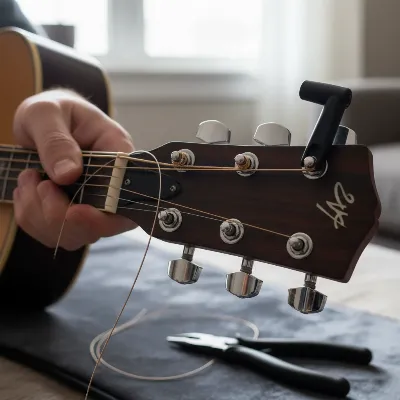 Close-up of hands installing new acoustic guitar strings on a headstock
Tuning and Stretching for Optimal Tone and Stability
Once all your new strings are installed, the journey isn’t quite complete. New strings require careful tuning and stretching to settle in and provide their best sound.
Begin by using your electronic tuner to bring each string up to its correct pitch. Start with the low E string and work your way up to the high E. Be mindful not to overtighten, as new strings are prone to breaking under sudden high tension. Once tuned, the next crucial step is stretching. Gently pull each string upward, away from the fretboard, around the 12th fret. You don’t need excessive force, just enough to feel a slight resistance. This helps “seat” the windings and relieve any initial slack in the string, which significantly improves tuning stability.
After stretching, you’ll notice the strings have gone flat. Re-tune each string again. You may need to repeat the stretch-and-tune process two or three times until the strings hold their pitch more consistently. Keep in mind that new strings will continue to stretch and settle over the next few days of playing, so expect to do some minor re-tuning each time you pick up your guitar. This patience will be rewarded with a guitar that stays in tune longer and delivers its best tone.
Expert Tips for a Faster and Easier String Change
Changing acoustic guitar strings doesn’t have to be a tedious task. With a few expert tips and a bit of practice, you can cut down your string changing time significantly.
One of the most impactful tips is to invest in a good quality string winder that ideally includes a built-in bridge pin puller and wire cutters. This all-in-one tool drastically reduces the time spent on winding and unwinding, and eliminates the need to switch between multiple tools. Furthermore, practice makes perfect; the more often you change your strings, the faster and more intuitive the process becomes. Consider setting a consistent winding pattern and stick to it for each string, creating muscle memory.
When installing strings, pre-kink the ball end slightly before inserting it into the bridge pin hole. This small bend helps the ball end seat more securely against the bridge plate, reducing slippage and ensuring a firm hold. Some experienced players also find that changing one string at a time (as opposed to removing all strings at once) helps maintain neck tension and can feel more manageable, especially when you’re aiming for speed without compromising safety. Finally, consider adding a touch of nut lubricant (like graphite from a pencil) to the nut slots when the strings are off. This can help prevent strings from binding, improving tuning stability and making future string changes smoother.
Common Mistakes Acoustic Guitarists Make When Changing Strings
Even seasoned guitarists can sometimes fall prey to common errors during a string change. Being aware of these pitfalls can save you time, frustration, and potential damage to your instrument.
One of the most critical mistakes is cutting strings while they are still under tension. This is not only dangerous due to the sudden release of energy but can also cause nicks or damage to your guitar’s finish or even the tuning pegs. Always loosen the strings completely before attempting to cut them. Another frequent error is incorrect winding on the tuning pegs. Strings that overlap, are wound unevenly, or are wound in the wrong direction can lead to poor tuning stability and premature string breakage. Always aim for neat, consistent downward wraps on the tuning post.
Failing to properly seat the bridge pins can result in the ball end of the string popping out, potentially scratching your guitar or causing a sudden, unwelcome sound. Ensure you pull up on the string while pushing the pin down to get a firm, secure fit. Neglecting to clean your fretboard while the strings are off is a missed opportunity for essential guitar maintenance. Dirt and grime can build up, affecting playability and the longevity of your instrument. Lastly, using the wrong string gauge for your guitar or playing style can negatively impact tone and may even put undue stress on your guitar’s neck. Always verify your guitar’s recommended string gauge before purchasing.
Conclusion
Mastering the art of changing acoustic guitar strings at home is a skill every guitarist should cultivate. It’s more than just routine maintenance; it’s an opportunity to revitalize your instrument, improve its tone, and deepen your connection with your music. By understanding the essential tools, following a methodical step-by-step process for removal and installation, and incorporating smart tips for tuning and stretching, you can ensure your acoustic guitar always sounds its best. Embrace this DIY approach to guitar care, and you’ll find yourself with a fresh-sounding instrument, ready for countless hours of joyful playing. What new songs will you learn, or old favorites will you rediscover, now that your acoustic guitar sings with renewed vibrancy?
Frequently Asked Questions
How often should I change my acoustic guitar strings?
|
Our Picks for the Best Acoustic Guitar in 2026
As an Amazon Associate I earn from qualifying purchases.
|
||
| Num | Product | Action |
|---|---|---|
| 1 | Moukey 38" Acoustic Guitar for Beginners Kids Youth Adult Dreadnought Guitarra Acustica Kit with Chord Poster, Gig Bag, Tuner, Picks, Nylon Strings, Capo, Strap - Black |

|
| 2 | Ashthorpe 38-inch Beginner Acoustic Guitar Package (Blue), Basic Starter Kit w/Gig Bag, Strings, Strap, Tuner, Pitch Pipe, Picks |
|
| 3 | Ashthorpe 41-inch Beginner Cutaway Acoustic Guitar Package (Sunburst), Full Size Basic Starter Kit w/Gig Bag, Strings, Strap, Tuner, Picks |
|
| 4 | Yamaha JR1 FG Junior 3/4 Size Acoustic Guitar, Natural |
|
| 5 | Joymusic 38 inch sunburst beginner acoustic guitar kit,bundle with a strap with picks holder,digital tuner, set strings, capo,cleaning cloth,6 picks,gig bag.(JG-38C,3TS) |
|
| 6 | Joymusic 38 inch brown beginner acoustic guitar kit,bundle with a strap with picks holder,digital tuner, set strings, capo,cleaning cloth,6 picks,gig bag.(JG-38C,BR) |
|
| 7 | Fender FA-25N 3/4 Size Nylon String Acoustic Guitar, Beginner Guitar, with 2-Year Warranty, Perfect Beginner Guitar for Kids that is Easy on Fingers, Includes 3 Months of Free Lessons, Natural |
|
| 8 | Pyle Beginner Acoustic Guitar Kit, 3/4 Junior Size All Wood Instrument with Full Accessory Kit, Picks, Shoulder Strap, Carry Case, Cleaning Cloth, Tuner App, 2 Month Lessons, 36” (Natural Gloss) |
|
| 9 | Joymusic 38 inch blueburst beginner acoustic guitar kit,bundle with a strap with picks holder,digital tuner, set strings, capo,cleaning cloth,6 picks,gig bag.(JG-38C,BLS) |
|
| 10 | 38inch Wood Acoustic Guitar for Adults, 6 Steel-String Acoustic Guitar With Guitar Bag, Elementary Tutorial of Folk Guitar for Beginners. |
|
The frequency of string changes depends largely on how often you play and your body chemistry. Casual players might change strings every three to four months, while those who play frequently or perform professionally may need to replace them every two to four weeks to maintain optimal tone and playability.
Can I change only one acoustic guitar string if it breaks?
While you can technically change a single broken string, it’s generally recommended to change the entire set. This ensures tonal consistency across all strings, as new strings will sound brighter and fresher than older ones, which can create an uneven sound profile.
What type of acoustic guitar strings should I use?
Acoustic guitar strings primarily come in bronze (80/20 Bronze) or phosphor bronze, offering different tonal qualities. Gauge (thickness) also varies, impacting playability and volume. Experimenting with different types can help you find what best suits your guitar and your preferred sound.
What happens if I don’t change my acoustic guitar strings regularly?
Neglecting string changes leads to a dull, muted tone, poor intonation, and reduced tuning stability. Strings can also become corroded, accumulate grime, and eventually break, making your guitar less enjoyable to play and potentially harder to tune accurately.
How much slack should I leave when winding new acoustic guitar strings?
The ideal amount of slack varies slightly by string thickness. For the thicker bass strings, aim for enough slack to allow two to three wraps around the tuning post (about 2-3 inches). For thinner treble strings, you might need a bit more slack, allowing for three to four wraps, which helps prevent slippage.
