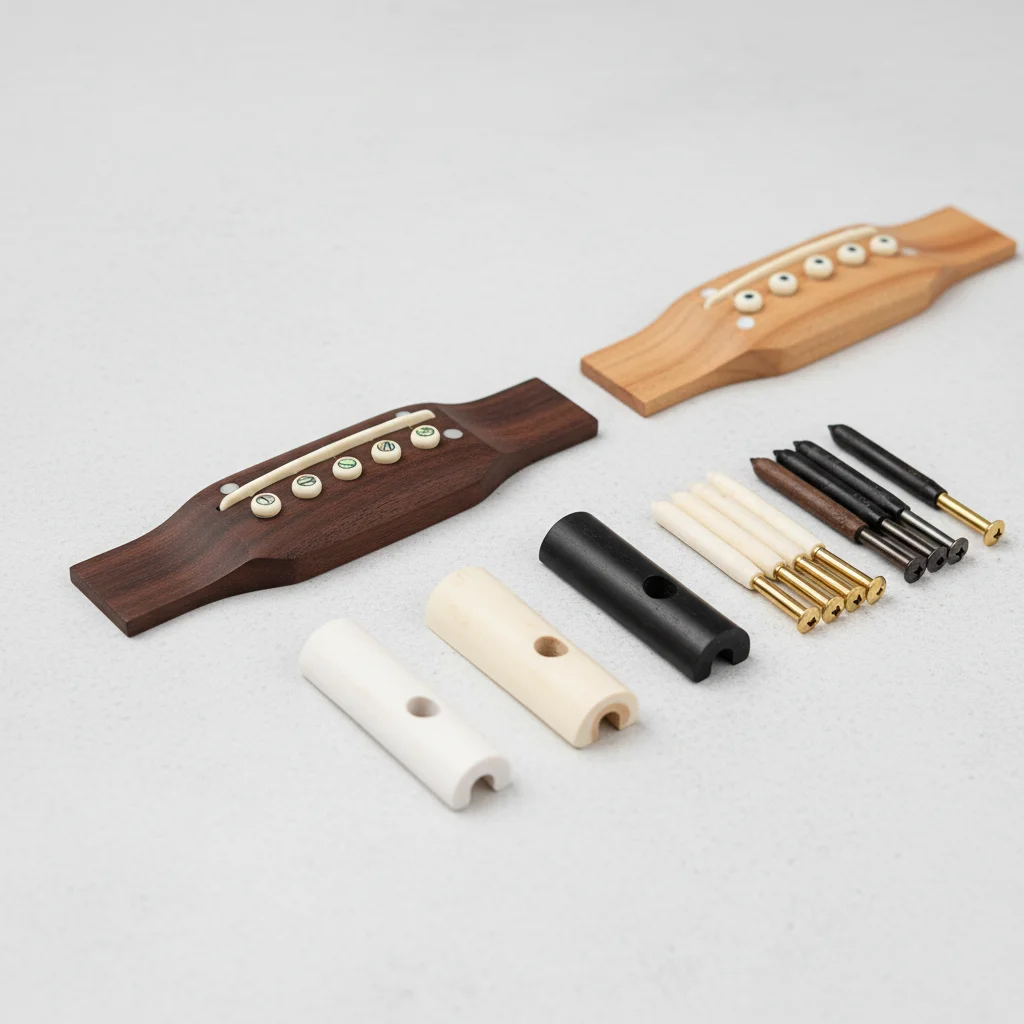
The material used for an acoustic guitar bridge can indeed affect its tone, primarily through its impact on vibration transfer and sustain. While often overlooked, the bridge acts as a crucial link between the strings and the guitar’s soundboard, influencing the instrument’s overall resonance and tonal characteristics. There are typically three main materials used for acoustic guitar bridges, each contributing distinct sonic qualities.
Understanding Bridge Function and Material Impact
The bridge’s primary role is to anchor the strings and transfer their vibrations to the guitar’s top. The efficiency and character of this transfer are heavily influenced by the bridge material’s density, hardness, and mass. A denser, harder material might transmit vibrations more directly and with greater clarity, potentially enhancing sustain and brightness. Conversely, a lighter, less dense material could absorb some vibrations, leading to a warmer, perhaps less resonant tone.
Consider the bridge as a conduit. Any resistance or inefficiency in this conduit will alter the sound. The choice of wood, or even synthetic materials, directly impacts how much energy from the vibrating strings reaches the soundboard to produce sound.
Rosewood Bridges: Warmth and Sustain
Rosewood is a very common material for acoustic guitar bridges, particularly Indian Rosewood. It is favored for its excellent tonal properties, offering a balanced sound with good warmth and sustain. Rosewood bridges tend to contribute to a rich, complex overtone series, making them a popular choice for guitars designed for a full, resonant sound. Its moderate density allows for efficient vibration transfer without being overly bright or harsh.
Many classic acoustic guitars feature rosewood bridges, a testament to its enduring appeal and sonic contributions. It pairs well with various body woods, providing a harmonious balance to the overall instrument’s voice.
Ebony Bridges: Clarity and Definition
|
Our Picks for the Best Acoustic Guitar in 2026
As an Amazon Associate I earn from qualifying purchases.
|
||
| Num | Product | Action |
|---|---|---|
| 1 | Ashthorpe 38-inch Beginner Acoustic Guitar Package (Blue), Basic Starter Kit w/Gig Bag, Strings, Strap, Tuner, Pitch Pipe, Picks |

|
| 2 | 38inch Wood Acoustic Guitar for Adults, 6 Steel-String Acoustic Guitar With Guitar Bag, Elementary Tutorial of Folk Guitar for Beginners. |
|
| 3 | Pyle Beginner Acoustic Guitar Kit, 3/4 Junior Size All Wood Instrument with Full Accessory Kit, Picks, Shoulder Strap, Carry Case, Cleaning Cloth, Tuner App, 2 Month Lessons, 36” (Natural Gloss) |
|
| 4 | Joymusic 38 inch blueburst beginner acoustic guitar kit,bundle with a strap with picks holder,digital tuner, set strings, capo,cleaning cloth,6 picks,gig bag.(JG-38C,BLS) |
|
| 5 | Joymusic 38 inch brown beginner acoustic guitar kit,bundle with a strap with picks holder,digital tuner, set strings, capo,cleaning cloth,6 picks,gig bag.(JG-38C,BR) |
|
| 6 | Yamaha JR1 FG Junior 3/4 Size Acoustic Guitar, Natural |
|
| 7 | Moukey 38" Acoustic Guitar for Beginners Kids Youth Adult Dreadnought Guitarra Acustica Kit with Chord Poster, Gig Bag, Tuner, Picks, Nylon Strings, Capo, Strap - Black |
|
| 8 | Joymusic 38 inch sunburst beginner acoustic guitar kit,bundle with a strap with picks holder,digital tuner, set strings, capo,cleaning cloth,6 picks,gig bag.(JG-38C,3TS) |
|
| 9 | Ashthorpe 41-inch Beginner Cutaway Acoustic Guitar Package (Sunburst), Full Size Basic Starter Kit w/Gig Bag, Strings, Strap, Tuner, Picks |
|
| 10 | Fender FA-25N 3/4 Size Nylon String Acoustic Guitar, Beginner Guitar, with 2-Year Warranty, Perfect Beginner Guitar for Kids that is Easy on Fingers, Includes 3 Months of Free Lessons, Natural |
|
Ebony is another popular choice for acoustic guitar bridges, known for its exceptional hardness and density. Bridges made from ebony often contribute to a brighter, more articulate tone with enhanced clarity and note separation. The dense nature of ebony allows for very direct and efficient transfer of string vibrations to the soundboard, resulting in a responsive and punchy sound. It’s often preferred by players who desire a crisp, defined attack.
While ebony can sometimes be more expensive due to its rarity and difficulty to work with, its sonic benefits are highly valued. It’s frequently found on higher-end instruments where tonal precision is a priority.
Other Bridge Materials: Ovangkol and Synthetic Options
Beyond rosewood and ebony, other materials are occasionally used for acoustic guitar bridges. Ovangkol, a wood with properties similar to rosewood, offers a balanced tone with good mid-range presence and sustain. It’s a sustainable alternative that provides excellent sonic characteristics. Some manufacturers also experiment with synthetic materials like Richlite, a composite material made from resin-infused paper. Richlite bridges are known for their consistency, stability, and often contribute to a clear, articulate tone, similar to ebony but with less environmental impact.
- Rosewood: Known for warmth, sustain, and rich overtones.
- Ebony: Favored for clarity, definition, and bright attack.
- Ovangkol: Offers balanced tone, good mid-range, and sustainability.
- Richlite: Provides consistency, stability, and clear articulation.
- Maple: Less common, can offer a very bright and direct tone.
Does Bridge Material Matter for Your Sound?
Ultimately, the impact of bridge material on tone is one piece of a larger puzzle that includes the top wood, back and side woods, bracing, saddle, and nut materials. However, it is a significant factor. For players seeking a warmer, more resonant sound, a rosewood bridge might be ideal. If clarity, definition, and a brighter attack are priorities, an ebony or Richlite bridge could be more suitable. The difference might be subtle to some ears, but for discerning players, it can be a crucial element in achieving their desired tonal palette.
When considering a new acoustic guitar or evaluating an existing one, paying attention to the bridge material can offer insights into its inherent tonal characteristics. It’s a component that, while small, plays a vital role in the overall voice of the instrument.
