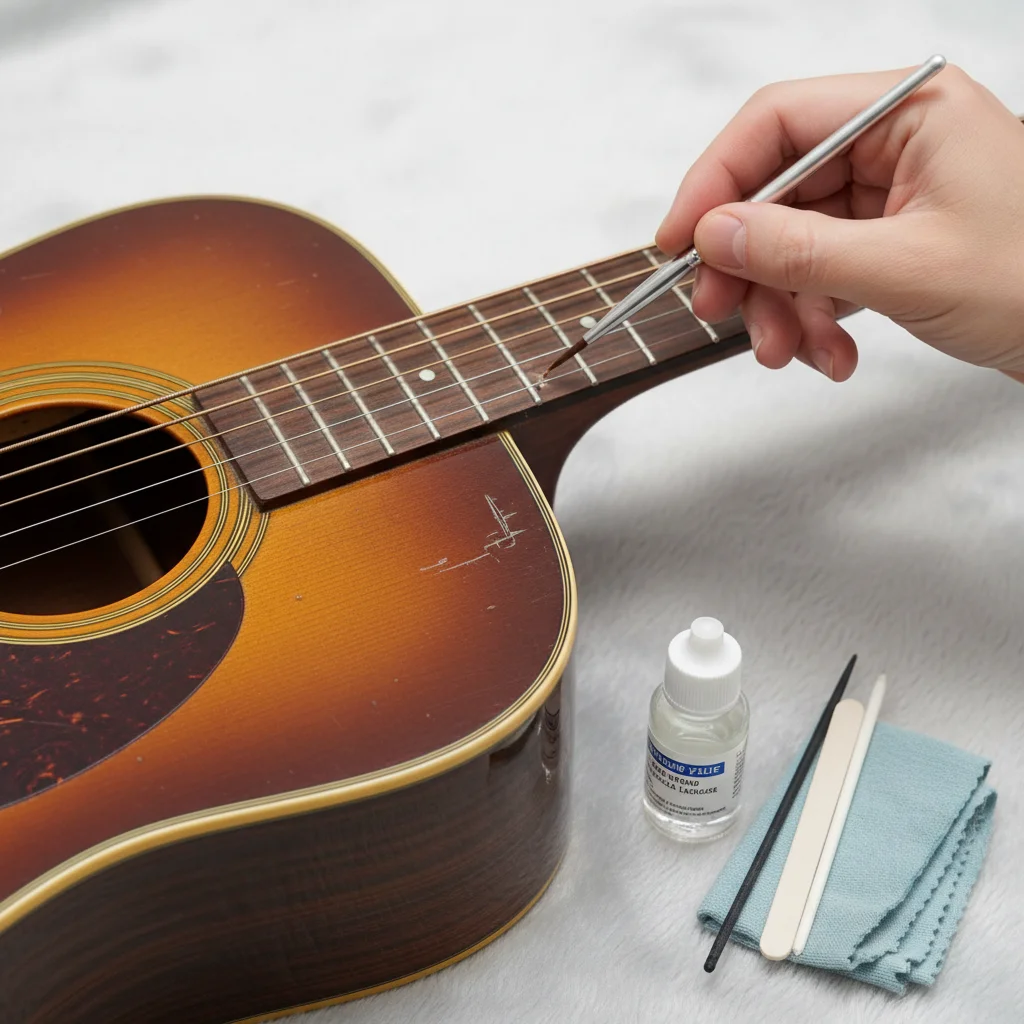
Acoustic guitar finish repair for minor dings and scratches is often achievable at home with the right tools and techniques, saving you the cost of professional intervention. While deep cracks or extensive damage typically require a luthier, surface imperfections can be addressed through a series of careful steps.
Understanding Acoustic Guitar Finishes
Acoustic guitars are typically finished with lacquer, polyurethane, or a thin satin coat. Each type of finish responds differently to repair methods. Lacquer, common on many vintage and high-end instruments, is relatively soft and can be ‘melted’ and blended with new lacquer for seamless repairs. Polyurethane, a harder and more durable finish, is more resistant to scratches but also more challenging to repair invisibly. Satin finishes, often a thinner application of lacquer or poly, require a delicate touch to maintain their matte appearance during repair.
Before attempting any repair, it’s crucial to identify your guitar’s finish type. This information can often be found on the manufacturer’s website or by consulting a guitar technician. Using the wrong repair product or technique can worsen the damage or create an even more noticeable blemish.
Gathering Your Repair Tools
For minor finish repairs, you’ll need a few essential items. These include fine-grit sandpaper (1500-2000 grit), polishing compounds (fine and ultra-fine), a soft microfiber cloth, and potentially a small amount of touch-up lacquer or super glue (cyanoacrylate) designed for instrument repair. For deeper scratches, a small artist’s brush or a toothpick can be useful for precise application of filler material.
- Fine-grit sandpaper (1500-2000 grit)
- Polishing compounds (fine and ultra-fine)
- Soft microfiber cloths
- Touch-up lacquer or instrument-grade super glue
- Small artist’s brush or toothpick
Always work in a clean, well-lit area to ensure you can clearly see the damage and your progress. Protecting the surrounding area with painter’s tape can prevent accidental damage to unaffected parts of the guitar.
Repairing Minor Scratches and Swirls
For light surface scratches and swirl marks, a polishing compound is often sufficient. Apply a small amount of fine polishing compound to a microfiber cloth and gently rub the affected area in small circular motions. Continue until the scratch diminishes, then switch to an ultra-fine compound for a high-gloss finish. This method works by removing a microscopic layer of the finish, leveling the surface.
Be cautious not to over-polish, especially on thin finishes, as this can wear through to the wood. Always test on an inconspicuous area first if you are unsure. This technique is particularly effective for removing pick marks and light scuffs that haven’t penetrated the finish.
Addressing Dings and Deeper Scratches
|
Our Picks for the Best Acoustic Guitar in 2026
As an Amazon Associate I earn from qualifying purchases.
|
||
| Num | Product | Action |
|---|---|---|
| 1 | Yamaha JR1 FG Junior 3/4 Size Acoustic Guitar, Natural |

|
| 2 | 38inch Wood Acoustic Guitar for Adults, 6 Steel-String Acoustic Guitar With Guitar Bag, Elementary Tutorial of Folk Guitar for Beginners. |
|
| 3 | Joymusic 38 inch blueburst beginner acoustic guitar kit,bundle with a strap with picks holder,digital tuner, set strings, capo,cleaning cloth,6 picks,gig bag.(JG-38C,BLS) |
|
| 4 | Ashthorpe 38-inch Beginner Acoustic Guitar Package (Blue), Basic Starter Kit w/Gig Bag, Strings, Strap, Tuner, Pitch Pipe, Picks |
|
| 5 | Fender FA-25N 3/4 Size Nylon String Acoustic Guitar, Beginner Guitar, with 2-Year Warranty, Perfect Beginner Guitar for Kids that is Easy on Fingers, Includes 3 Months of Free Lessons, Natural |
|
| 6 | Joymusic 38 inch brown beginner acoustic guitar kit,bundle with a strap with picks holder,digital tuner, set strings, capo,cleaning cloth,6 picks,gig bag.(JG-38C,BR) |
|
| 7 | Pyle Beginner Acoustic Guitar Kit, 3/4 Junior Size All Wood Instrument with Full Accessory Kit, Picks, Shoulder Strap, Carry Case, Cleaning Cloth, Tuner App, 2 Month Lessons, 36” (Natural Gloss) |
|
| 8 | Joymusic 38 inch sunburst beginner acoustic guitar kit,bundle with a strap with picks holder,digital tuner, set strings, capo,cleaning cloth,6 picks,gig bag.(JG-38C,3TS) |
|
| 9 | Ashthorpe 41-inch Beginner Cutaway Acoustic Guitar Package (Sunburst), Full Size Basic Starter Kit w/Gig Bag, Strings, Strap, Tuner, Picks |
|
| 10 | Moukey 38" Acoustic Guitar for Beginners Kids Youth Adult Dreadnought Guitarra Acustica Kit with Chord Poster, Gig Bag, Tuner, Picks, Nylon Strings, Capo, Strap - Black |
|
Deeper dings and scratches that have gone through the finish require a more involved approach. For these, you’ll need to fill the void. Instrument-grade super glue (cyanoacrylate) is a popular choice for this. Apply a tiny drop of glue directly into the ding or scratch, allowing it to slightly overfill the area. Let it cure completely, which can take several hours depending on the glue type and humidity.
Once cured, carefully level the excess glue using a razor blade held at a very shallow angle, or by wet-sanding with extremely fine-grit sandpaper (2000 grit or higher). The goal is to make the filled area flush with the surrounding finish without creating new scratches. This process requires patience and a very light touch.
Polishing and Finishing Touches
After leveling the repair, the area will likely appear dull. This is where the polishing compounds come back into play. Start with a fine polishing compound to remove any sanding marks, then move to an ultra-fine compound to restore the original sheen. Work slowly and methodically, ensuring the entire repaired area is uniformly polished.
For a truly professional look, consider using a guitar-specific wax or polish after the repair is complete. This will not only enhance the shine but also provide a layer of protection. Remember that perfect invisibility is often difficult to achieve, but a significant improvement is well within reach for most DIY enthusiasts.
Preventative Measures and Ongoing Care
The best way to deal with finish damage is to prevent it in the first place. Always store your acoustic guitar in a proper case or gig bag when not in use. Be mindful of your surroundings when playing, avoiding contact with buckles, buttons, or other abrasive objects. Regularly cleaning your guitar with a soft, dry cloth can also help prevent the buildup of grime that can lead to minor scratches over time.
Consider investing in a high-quality guitar stand that securely holds your instrument and prevents accidental falls. Even a small bump can result in a significant ding. With proper care and attention, your acoustic guitar’s finish can remain beautiful for many years, preserving both its aesthetic appeal and its resale value.

This was a lifesaver! I bought a used guitar with a few minor surface imperfections and was hesitant about trying to fix them myself. The detailed steps for addressing dings and scratches gave me the confidence to go for it. My guitar looks so much better now, and I didn’t have to pay for a professional repair. Highly recommend these techniques!
I tried to fix a small scratch on my satin finish guitar, but it was trickier than I thought. While the scratch itself is less noticeable, I ended up with a slightly shinier spot where I worked on it. It’s not terrible, but it definitely changed the matte appearance a bit. I guess satin finishes really do require a delicate touch, as mentioned.
My Taylor has a polyurethane finish, and I’ve always been told those are super hard to fix. I had a few light pick scratches near the soundhole that were driving me crazy. Following the advice for harder finishes, I was able to buff them out significantly. It took a bit more elbow grease than I expected, but the results are definitely worth it. Glad I gave it a try!
I had a nasty ding on my Martin D-28’s lacquer finish from a mic stand incident. I was really worried I’d have to take it to a luthier, but the tips here for blending new lacquer worked wonders. It’s not 100% invisible if you really scrutinize it, but for a home repair, I’m incredibly impressed. Saved me a ton of money and my guitar looks great again.