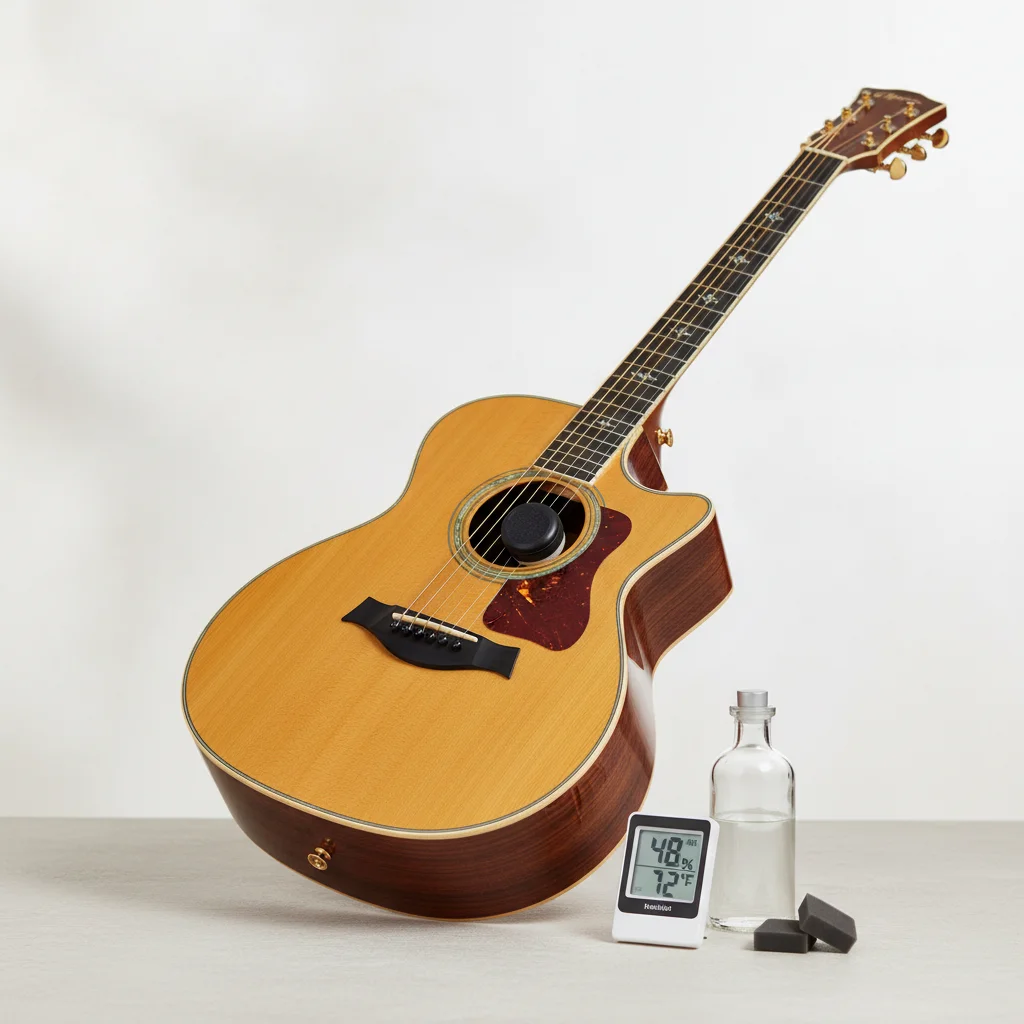
Maintaining the correct acoustic guitar humidity is crucial for its longevity and optimal sound. The ideal relative humidity for an acoustic guitar is between 45% and 55%. Deviations outside this range can lead to significant structural damage, affecting playability and tone. Understanding and controlling the humidity around your instrument is one of the most important aspects of acoustic guitar care.
Why Humidity Matters for Acoustic Guitars
Acoustic guitars are primarily made of wood, a hygroscopic material that readily absorbs and releases moisture from the air. When the humidity is too low, the wood dries out, shrinks, and can crack, especially on the soundboard and back. This can also cause the neck to bow backward, frets to protrude, and the bridge to lift. Conversely, excessively high humidity causes the wood to swell, leading to a duller tone, a higher action, and potential glue joint failures. Both extremes are detrimental to the instrument’s health and performance. For compare top acoustic guitar on this site.
Signs of Improper Humidity Levels
Recognizing the signs of improper humidity is key to preventing irreversible damage. In a dry environment, you might notice sharp fret ends, a sunken top, a lower action, or even visible cracks in the wood. The guitar’s tone may become brighter and thinner. In a humid environment, the guitar might feel heavy, the action could rise significantly, and the tone might sound muffled or less resonant. The top might appear swollen or bulging. Regularly inspecting your guitar for these indicators can help you take corrective action promptly.
Effective Humidity Control Methods
|
Our Picks for the Best Acoustic Guitar in 2026
As an Amazon Associate I earn from qualifying purchases.
|
||
| Num | Product | Action |
|---|---|---|
| 1 | Moukey 38" Acoustic Guitar for Beginners Kids Youth Adult Dreadnought Guitarra Acustica Kit with Chord Poster, Gig Bag, Tuner, Picks, Nylon Strings, Capo, Strap - Black |

|
| 2 | Joymusic 38 inch sunburst beginner acoustic guitar kit,bundle with a strap with picks holder,digital tuner, set strings, capo,cleaning cloth,6 picks,gig bag.(JG-38C,3TS) |
|
| 3 | Joymusic 38 inch brown beginner acoustic guitar kit,bundle with a strap with picks holder,digital tuner, set strings, capo,cleaning cloth,6 picks,gig bag.(JG-38C,BR) |
|
| 4 | Ashthorpe 38-inch Beginner Acoustic Guitar Package (Blue), Basic Starter Kit w/Gig Bag, Strings, Strap, Tuner, Pitch Pipe, Picks |
|
| 5 | Pyle Beginner Acoustic Guitar Kit, 3/4 Junior Size All Wood Instrument with Full Accessory Kit, Picks, Shoulder Strap, Carry Case, Cleaning Cloth, Tuner App, 2 Month Lessons, 36” (Natural Gloss) |
|
| 6 | Fender FA-25N 3/4 Size Nylon String Acoustic Guitar, Beginner Guitar, with 2-Year Warranty, Perfect Beginner Guitar for Kids that is Easy on Fingers, Includes 3 Months of Free Lessons, Natural |
|
| 7 | Yamaha JR1 FG Junior 3/4 Size Acoustic Guitar, Natural |
|
| 8 | Ashthorpe 41-inch Beginner Cutaway Acoustic Guitar Package (Sunburst), Full Size Basic Starter Kit w/Gig Bag, Strings, Strap, Tuner, Picks |
|
| 9 | Joymusic 38 inch blueburst beginner acoustic guitar kit,bundle with a strap with picks holder,digital tuner, set strings, capo,cleaning cloth,6 picks,gig bag.(JG-38C,BLS) |
|
| 10 | 38inch Wood Acoustic Guitar for Adults, 6 Steel-String Acoustic Guitar With Guitar Bag, Elementary Tutorial of Folk Guitar for Beginners. |
|
There are several reliable methods to maintain optimal humidity for your acoustic guitar. For individual instruments, in-case humidifiers are highly effective. These devices release moisture slowly and consistently within the enclosed space of the guitar case. Room humidifiers or dehumidifiers can be used for collections of guitars or in environments with extreme fluctuations. Always use a hygrometer to monitor the relative humidity accurately, both inside the case and in the room where the guitar is stored.
- Use an in-case humidifier for targeted moisture control.
- Monitor humidity levels with a reliable hygrometer.
- Store your guitar in its hard-shell case when not in use.
- Avoid direct sunlight, heating vents, and air conditioning.
- Consider a room humidifier/dehumidifier for extreme conditions.
Long-Term Care and Prevention
Consistent humidity control is not a one-time fix but an ongoing commitment. Even if your guitar seems fine, regular monitoring and adjustment are essential, especially during seasonal changes. Winter months often bring lower humidity due to heating systems, while summer can introduce high humidity. Investing in a good quality hard-shell case provides an additional layer of protection and helps stabilize the microclimate around your instrument. Never leave your guitar exposed to the elements for extended periods.
Impact on Tone and Playability
Beyond structural integrity, proper humidity significantly impacts your guitar’s tone and playability. A guitar kept at ideal humidity will resonate more freely, producing a richer, more balanced sound. The wood can vibrate optimally, allowing for better sustain and projection. When the wood is too dry or too wet, its ability to vibrate is compromised, leading to a less vibrant and less expressive tone. Furthermore, stable humidity ensures consistent action and neck relief, making the guitar more comfortable and enjoyable to play.
