Choosing between an acoustic and classical guitar depends on your musical style, comfort, and playing goals. Steel-string acoustic guitars offer a bright, loud sound with narrower necks, ideal for strumming and energetic flatpicking in genres like folk, rock, and country. Classical guitars, with their nylon strings, wider necks, and traditional construction, provide a warm, mellow, and intimate tone, perfect for delicate fingerstyle, classical repertoire, flamenco, and Latin music.
Different Types of Acoustic Guitars: Steel-String vs. Nylon-String
The term “acoustic guitar” broadly encompasses any guitar that produces sound naturally, but in common parlance, it typically refers to the steel-string variant. The critical distinction begins with their strings and leads to profound differences in body design, neck profile, and overall tonal character.
Body Styles
The physical shape and size of a guitar’s body significantly influence its volume, tone, and projection. Both acoustic and classical guitars feature distinct body styles tailored to their intended sounds and playing experiences.
Acoustic Guitars (Steel-String)
Steel-string acoustic guitars come in a variety of body shapes, each designed to produce a specific tonal response and volume.
- Dreadnought: This iconic shape is known for its large, boxy body and wide shoulders, producing a loud, robust, and bass-heavy tone. Dreadnoughts are excellent for powerful strumming and flatpicking in folk, country, and bluegrass.
- Grand Auditorium (GA), Concert (OM), and Orchestra (000): These mid-sized body shapes offer a more balanced tone with clear articulation across all frequencies. They are versatile for both strumming and fingerstyle, with comfortable sizes and ergonomic curves.
- Parlor: Characterized by their small, compact size, parlor guitars offer a charming, intimate, and warm sound with a strong mid-range presence. They are highly portable and comfortable for seated playing, favored by blues and fingerstyle players.
- Jumbo: Among the largest acoustic body styles, jumbo guitars have an expansive lower bout that contributes to a powerful, resonant, and bass-rich sound, often described as “bell-like.” They are ideal for strong strumming and vocal accompaniment.
- Travel Guitar: These guitars are significantly smaller and more portable, designed for musicians on the go. While their sound projection and bass response are reduced, they offer unparalleled convenience for practice or travel.
Classical Guitars (Nylon-String)
Classical guitars feature a more uniform body shape that has remained largely unchanged for centuries.
- Classical guitars typically have a smaller, lighter, and more compact body with a distinctive “figure-eight” shape. This design is optimized for seated performance, allowing for comfortable posture while playing intricate fingerstyle pieces. Their construction contributes to a warm, mellow, and intimate sound with less overall volume and projection compared to steel-string acoustics.
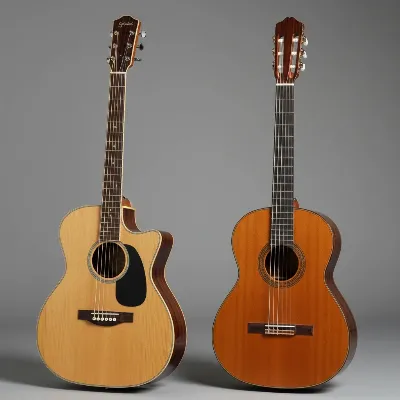 Comparing the distinct body shapes and sizes of acoustic and classical guitars, highlighting their structural differences
Tonewoods
|
Our Picks for the Best Acoustic Guitar in 2026
As an Amazon Associate I earn from qualifying purchases.
|
||
| Num | Product | Action |
|---|---|---|
| 1 | Fender FA-25N 3/4 Size Nylon String Acoustic Guitar, Beginner Guitar, with 2-Year Warranty, Perfect Beginner Guitar for Kids that is Easy on Fingers, Includes 3 Months of Free Lessons, Natural |

|
| 2 | Ashthorpe 38-inch Beginner Acoustic Guitar Package (Blue), Basic Starter Kit w/Gig Bag, Strings, Strap, Tuner, Pitch Pipe, Picks |
|
| 3 | Yamaha JR1 FG Junior 3/4 Size Acoustic Guitar, Natural |
|
| 4 | Joymusic 38 inch sunburst beginner acoustic guitar kit,bundle with a strap with picks holder,digital tuner, set strings, capo,cleaning cloth,6 picks,gig bag.(JG-38C,3TS) |
|
| 5 | Pyle Beginner Acoustic Guitar Kit, 3/4 Junior Size All Wood Instrument with Full Accessory Kit, Picks, Shoulder Strap, Carry Case, Cleaning Cloth, Tuner App, 2 Month Lessons, 36” (Natural Gloss) |
|
| 6 | Joymusic 38 inch brown beginner acoustic guitar kit,bundle with a strap with picks holder,digital tuner, set strings, capo,cleaning cloth,6 picks,gig bag.(JG-38C,BR) |
|
| 7 | Moukey 38" Acoustic Guitar for Beginners Kids Youth Adult Dreadnought Guitarra Acustica Kit with Chord Poster, Gig Bag, Tuner, Picks, Nylon Strings, Capo, Strap - Black |
|
| 8 | Joymusic 38 inch blueburst beginner acoustic guitar kit,bundle with a strap with picks holder,digital tuner, set strings, capo,cleaning cloth,6 picks,gig bag.(JG-38C,BLS) |
|
| 9 | Ashthorpe 41-inch Beginner Cutaway Acoustic Guitar Package (Sunburst), Full Size Basic Starter Kit w/Gig Bag, Strings, Strap, Tuner, Picks |
|
| 10 | 38inch Wood Acoustic Guitar for Adults, 6 Steel-String Acoustic Guitar With Guitar Bag, Elementary Tutorial of Folk Guitar for Beginners. |
|
The selection of tonewoods is paramount to a guitar’s acoustic properties, significantly influencing its sound, resonance, and even how it “ages.” Different woods offer distinct tonal characteristics, and their combination across the guitar’s various parts creates its unique voice.
Solid Wood
Solid wood refers to a single piece of wood used for a guitar’s components. Guitars with solid tops, or even all-solid construction (solid top, back, and sides), are highly prized.
- Advantages: Solid tonewoods produce a more sophisticated, nuanced sound that tends to improve and “open up” over time as the wood’s cellular structure loosens and vibrates more freely. They offer superior resonance, sustain, and harmonic complexity.
- Common Top Woods: The guitar’s top, or soundboard, is the most critical component for sound production.
- Spruce (Sitka, Engelmann, Adirondack): This is the most common and versatile top wood, offering a bright, clear, and responsive tone with a broad dynamic range. Sitka spruce is known for strength and clarity, Engelmann for a warmer tone, and Adirondack for stiffness and high volume.
- Cedar: Frequently used for classical and some fingerstyle acoustic guitars, cedar is softer and less dense than spruce. It produces a warmer, more complex sound with a quicker response and higher overtones, ideal for a softer attack.
- Common Back & Side Woods: These woods primarily influence the guitar’s sustain, overtones, and overall tonal color.
- Rosewood (Indian, Brazilian): A highly dense and resonant wood, known for its deep lows, sparkling highs, and rich, complex overtones. Indian rosewood offers a warm and resonant tone.
- Mahogany: Offers a warm, woody tone with a focused midrange and less overtone complexity than rosewood, excellent for clarity and fundamental note projection.
- Maple: A very dense wood that produces a bright, crisp, and articulate tone with fast note decay and minimal overtones.
- Koa: Primarily from Hawaii, koa starts bright and focused but mellows and gains warmth and richness with age and playing.
- Sapele: A sustainable alternative to mahogany, sapele provides a consistent and balanced tonal output, often described as having a slightly brighter top-end shimmer.
Laminate Wood
Laminated wood consists of several thin sheets of wood glued together, often with a decorative veneer on the outside.
- Advantages: Laminated guitars are generally more affordable, more durable, and less susceptible to changes in humidity and temperature, making them a practical choice for beginners or travel.
- Disadvantages: They offer less resonance, sustain, and tonal complexity compared to solid wood, and their sound does not “open up” or improve significantly with age.
The combination of different tonewoods is key; for instance, a spruce top combined with rosewood back and sides offers a bright attack with deep, rich bass, while a cedar top with mahogany back and sides typically yields a warmer, softer tone with a strong midrange focus.
Comparing Leading Acoustic Guitar Brands
The landscape of guitar manufacturing is rich with storied brands, each renowned for particular qualities and innovations. Understanding the characteristics associated with top brands can guide your selection.
Famous Brands Comparison:
- Taylor: (Acoustic) Known for modern playability, bright and balanced tone, and comfortable, fast necks. Taylor often features innovative construction techniques and emphasizes consistency and precision.
- Martin: (Acoustic) A legendary brand, Martin guitars are celebrated for their traditional, powerful, and rich tone, especially their dreadnoughts. They are known for deep bass, exceptional projection, and a classic “woody” sound.
- Yamaha: (Acoustic & Classical) Yamaha stands out for offering exceptional value across various price points. Their guitars are known for reliable build quality, consistent sound, and great playability, recommended for beginners and intermediate players.
- Fender: (Acoustic) While globally recognized for electric guitars, Fender also produces a range of acoustic guitars, particularly strong in the beginner and intermediate categories.
- Gibson: (Acoustic) Famous for its iconic “workhorse” dreadnought, the J-45, and the majestic Jumbo SJ-200. Gibson acoustics are celebrated for their warm, woody, and earthy tone, often with a strong midrange.
- Cordoba: (Classical) A leading brand exclusively focused on classical and flamenco guitars. Cordoba offers a wide range of models, lauded for their authentic Spanish sound and quality craftsmanship.
- Alhambra: (Classical) Handcrafted in Spain, Alhambra guitars embody authentic Spanish construction and traditional tone. They provide quality instruments for various skill levels.
Comparison Criteria:
When evaluating guitars, consider these factors:
- Sound Quality:
- Steel-string acoustics: Produce a brighter, louder, and more resonant sound with a broader dynamic range. Ideal for strumming chords, flatpicking, and cutting through a mix in genres like pop, rock, folk, and country.
- Nylon-string classicals: Deliver a warmer, mellower, and softer sound, with a focus on individual note clarity and a rich mid-range. They excel in intricate fingerstyle playing, classical compositions, flamenco, and Latin music.
- Durability: Steel-string acoustics are built more robustly to withstand the higher tension of steel strings, often incorporating a truss rod. Classical guitars, designed for lower-tension nylon strings, typically have a lighter build and may lack a truss rod.
- Price: The price range for both types varies significantly, from a few hundred dollars for beginner models to several thousands for professional instruments. Guitars with a solid top generally offer better sound quality and a higher price.
- Design/Aesthetics:
- Acoustic guitars: Feature various body shapes, a solid headstock with vertical metal tuning pegs, and often fret markers.
- Classical guitars: Tend to have a more uniform, traditional body shape, a slotted headstock with horizontal plastic or metal tuning pegs, a wider neck, a flatter fretboard, and typically no fret markers.
- Support/Warranty: Purchasing from reputable brands often ensures better customer support, warranty coverage, and access to service and parts.
Choosing Your Perfect Acoustic Guitar (Buying Guide)
Selecting the right guitar is a personal journey. Your ideal instrument should align with your physical comfort, musical taste, and playing goals.
Define Your Needs and Budget
Before you even start looking, consider what you want from your guitar.
- Purpose of Use: Are you looking for an instrument for casual practice, serious lessons, recording, or live performances? Consider acoustic-electric models if amplification is needed.
- Musical Style/Genre: If you gravitate towards bright, percussive sounds of folk, rock, pop, or country, a steel-string acoustic is likely best. For warm, intimate tones of classical, flamenco, or Latin music, a nylon-string classical guitar is more appropriate.
- Budget: Entry-level guitars (under $300-$500) are typically laminated, while mid-range (up to $1000-$1500) often feature solid tops. High-end instruments (over $1500) usually boast all-solid wood construction.
Key Factors to Consider
Once your needs are clear, delve into the specifics of the guitar itself.
- Body Style for Comfort:
- Steel-String Acoustic: Smaller individuals might prefer parlor or Grand Auditorium shapes. Dreadnoughts offer power but can be less comfortable for extended seated play.
- Nylon-String Classical: Their generally smaller and more consistent body shape is designed for seated playing comfort, but the wider neck can be a consideration.
- Tonewoods and Sound: A solid wood top is almost always recommended for its superior tone and ability to improve with age. Consider back and side woods based on desired tonal color: rosewood for rich overtones, mahogany for focused midrange, maple for brightness.
- Neck Comfort and Playability:
- Steel-string Acoustic: Generally features a narrower neck (around 1.7 inches at the nut) and a slightly curved fretboard radius, facilitating easier chord transitions. The higher tension of steel strings can be tougher on fingertips initially.
- Nylon-string Classical: Has a significantly wider neck (typically 2 inches or more at the nut) and a flat fretboard. This wider string spacing is ideal for precise fingerstyle techniques. The lower tension of nylon strings is much softer on the fingers, often recommended for beginners.
- Inspection of Details: Carefully examine the guitar’s construction.
- Tuning Pegs: Steel-string acoustics have solid headstocks with exposed, vertical metal tuning pegs. Classical guitars feature a slotted headstock with horizontal plastic/metal tuning pegs.
- Bridge: Steel-string acoustics usually have a pin-style bridge. Classical guitars use a tie-block bridge where nylon strings are tied directly.
- Fretwork: Ensure frets are smooth, evenly spaced, and free from sharp edges.
- Action: Check the string height (action) above the fretboard. It should be comfortable to press down without buzzing.
 A detailed checklist for buying an acoustic or classical guitar, covering body style, tonewoods, neck, and playability
Where to Buy
- Reputable Music Stores: Whenever possible, visit a physical store to try out different models, feel their comfort, and hear their actual sound. Staff can offer personalized advice.
- Online Retailers: Online stores offer vast selection and competitive prices. If buying online, ensure a clear and generous return policy.
Essential Accessories for Your Acoustic Guitar
A selection of essential accessories will enhance your playing experience, help maintain your instrument, and expand your musical capabilities.
- Picks: For steel-string players, picks come in various thicknesses. Thinner picks (0.40-0.60mm) are better for strumming, while thicker picks (0.73mm+) offer more control for lead playing. Classical guitarists primarily use their fingernails or fingertips.
- Capo: A capo clamps across the fretboard, raising the pitch of all strings simultaneously, allowing you to play familiar chord shapes in different keys. Specific capos exist for classical and steel-string guitars.
- Tuner: Essential for keeping your guitar in tune. Options include clip-on tuners, pedal tuners, and smartphone apps.
- Strings: Always keep spare sets. Steel-string acoustics use steel strings (phosphor bronze or 80/20 bronze), while classical guitars exclusively use nylon strings. Using steel strings on a classical guitar can cause severe structural damage.
- Gig Bag or Hard Case: Crucial for protecting your instrument during transport and storage. A gig bag offers basic protection, while a hard case provides superior impact resistance.
- Guitar Stand: Keeps your guitar safely upright and accessible, preventing accidental falls and encouraging more frequent practice.
- Humidifier: Especially vital for solid wood guitars, a humidifier helps maintain ideal humidity (typically 45-55%) to prevent drying out, cracking, or warping.
- Metronome: An invaluable tool for developing consistent rhythm, timing, and tempo control.
- Guitar Strap: Essential for steel-string acoustic players who play standing up. Classical guitarists typically play seated, but some might use a special support or strap.
Conclusion
Choosing between an acoustic and classical guitar boils down to understanding their fundamental differences and aligning them with your personal musical journey. Steel-string acoustic guitars, with their bright, loud sound, narrower necks, and steel strings, are versatile workhorses for a vast array of modern genres, from folk and rock to pop and country. Classical guitars, conversely, provide a warm, mellow, and intimate tone, thanks to their nylon strings, wider necks, and traditional construction. They are the quintessential choice for delicate fingerstyle, classical repertoire, flamenco, and Latin music, offering unparalleled dynamic control and a gentle touch on the fingertips.
Ultimately, there is no single “best” guitar; only the best guitar for you. Your preferred musical style, comfort, budget, and long-term playing goals should guide your decision. Take the time to explore, listen, and ideally, play both types of instruments. Embrace the unique characteristics each offers, and you’ll find an instrument that not only suits your hands but also ignites your musical passion. What musical stories will your chosen guitar help you tell?
Frequently Asked Questions
Choose Your Perfect Acoustic Guitar
Selecting the right guitar involves defining your needs and budget, then considering key factors like body style, tonewoods, neck comfort, and playability.
Determine the guitar's purpose (practice, lessons, recording, performance) and your preferred musical style (folk, rock, classical, flamenco). Set a realistic budget, noting that entry-level guitars are typically laminated, mid-range often feature solid tops, and high-end instruments boast all-solid wood construction.
For steel-string acoustics, smaller players might prefer parlor or Grand Auditorium shapes, while dreadnoughts offer power but can be less comfortable. Classical guitars have a consistent body shape designed for seated comfort, but their wider neck is a factor.
Prioritize a solid wood top for superior tone and improvement with age. Choose back and side woods based on desired tonal color: rosewood for rich overtones, mahogany for focused midrange, or maple for brightness.
Steel-string acoustics have narrower necks and curved fretboards, good for chord transitions, but steel strings are tougher on fingers. Classical guitars have wider, flatter necks ideal for precise fingerstyle, and softer nylon strings are gentler on hands.
Examine tuning pegs, bridge type, fretwork, and string action. Visit reputable music stores to try models in person or buy from online retailers with generous return policies.

I was torn between an acoustic and a classical for fingerstyle. The info about the wider neck on classical guitars being better for delicate fingerstyle really sealed the deal for me. It’s so much more comfortable for intricate pieces. I’m glad I read this before making a purchase.
I appreciate the breakdown, but I found the discussion on body styles a little brief. I was hoping for more detail on how different body shapes affect the tone, especially for steel-string acoustics. Still, it was helpful in confirming that a classical guitar’s mellow tone is what I need for my Latin music studies.
This was super helpful! I’m a beginner and was so confused about which type to get. Knowing that steel-string acoustics are great for strumming and energetic flatpicking in country music made my decision easy. I’m excited to start learning with the right instrument for my goals.
I’ve always played electric, but wanted to get into something more unplugged. This really helped me understand the difference between steel-string and nylon-string. I ended up going with a steel-string acoustic for its versatility in folk and rock. The brighter sound is exactly what I was looking for to accompany my singing.