Lowering your acoustic guitar’s action at home is achievable with a few simple tools and a methodical approach, typically involving adjustments to the truss rod and saddle. Optimal action, generally between 2/32″ to 3/32″ at the 12th fret, enhances playability, reduces finger fatigue, and allows for clearer notes, transforming the instrument’s feel and unlocking its full potential.
Understanding Acoustic Guitar Action
Acoustic guitar action refers to the height of the strings above the fretboard. This seemingly small detail profoundly impacts how your guitar feels and sounds. Optimal action allows for comfortable playing, reduces finger fatigue, and enables faster chord changes and intricate solos. Conversely, high action makes the guitar harder to fret, requiring more pressure and effort, while extremely low action can lead to frustrating string buzzing. Finding the right balance is crucial for both beginners learning fundamental chords and experienced players seeking fluid expression. The ideal action can vary based on your playing style, string gauge, and personal preference, but a general target for the 12th fret is often between 2/32″ to 3/32″ on the treble side and slightly higher on the bass side.
Essential Tools for Action Adjustment
Before you dive into adjusting your acoustic guitar’s action, gathering the right tools is essential. While some adjustments are straightforward, others require precision. Having these items on hand will ensure a smooth and accurate process:
- Ruler or String Action Gauge: A precise ruler, preferably one with measurements in 64ths of an inch or millimeters, is crucial for accurately measuring string height at various points on the fretboard. Dedicated string action gauges offer even greater accuracy.
- Allen Wrench (Truss Rod Wrench): If your guitar has a truss rod (most modern acoustics do), you’ll need the correct size Allen wrench to adjust neck relief. The size can vary between manufacturers.
- Fine-Grit Sandpaper (150-220 grit): Essential for carefully sanding down the saddle. Ensure you have a flat, stable surface, like a glass pane or a thick book, to place the sandpaper on.
- Pencil and Masking Tape: Useful for marking the saddle and for protecting parts of your guitar.
- Small Screwdriver or Pliers: For carefully removing bridge pins and the saddle. Long-nosed pliers can be helpful if the saddle is tight.
- New Strings (Optional but Recommended): If your strings are old, consider replacing them before making adjustments, as new strings can affect neck tension and action.
- Nut Files (Advanced): Specialized files designed to adjust the height of individual string slots in the nut. This is an advanced step, and often best left to a professional if you’re unsure.
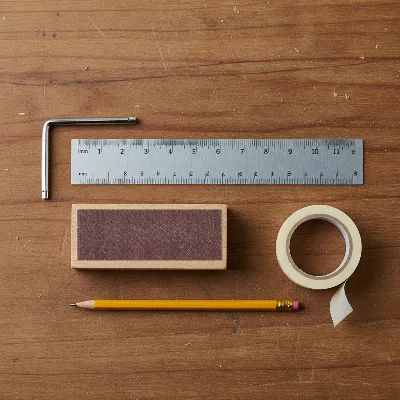 A collection of essential tools for acoustic guitar action adjustment, including a ruler, Allen wrench, sandpaper, and pencil.
Step-by-Step Guide: Lowering Acoustic Guitar Action
Lowering your acoustic guitar’s action involves a systematic approach, addressing different components in a specific order to achieve optimal playability without introducing fret buzz or intonation issues.
Step 1: Assess Current Action and Identify Issues
|
Our Picks for the Best Acoustic Guitar in 2026
As an Amazon Associate I earn from qualifying purchases.
|
||
| Num | Product | Action |
|---|---|---|
| 1 | Ashthorpe 41-inch Beginner Cutaway Acoustic Guitar Package (Sunburst), Full Size Basic Starter Kit w/Gig Bag, Strings, Strap, Tuner, Picks |

|
| 2 | Joymusic 38 inch sunburst beginner acoustic guitar kit,bundle with a strap with picks holder,digital tuner, set strings, capo,cleaning cloth,6 picks,gig bag.(JG-38C,3TS) |
|
| 3 | 38inch Wood Acoustic Guitar for Adults, 6 Steel-String Acoustic Guitar With Guitar Bag, Elementary Tutorial of Folk Guitar for Beginners. |
|
| 4 | Fender FA-25N 3/4 Size Nylon String Acoustic Guitar, Beginner Guitar, with 2-Year Warranty, Perfect Beginner Guitar for Kids that is Easy on Fingers, Includes 3 Months of Free Lessons, Natural |
|
| 5 | Ashthorpe 38-inch Beginner Acoustic Guitar Package (Blue), Basic Starter Kit w/Gig Bag, Strings, Strap, Tuner, Pitch Pipe, Picks |
|
| 6 | Yamaha JR1 FG Junior 3/4 Size Acoustic Guitar, Natural |
|
| 7 | Moukey 38" Acoustic Guitar for Beginners Kids Youth Adult Dreadnought Guitarra Acustica Kit with Chord Poster, Gig Bag, Tuner, Picks, Nylon Strings, Capo, Strap - Black |
|
| 8 | Pyle Beginner Acoustic Guitar Kit, 3/4 Junior Size All Wood Instrument with Full Accessory Kit, Picks, Shoulder Strap, Carry Case, Cleaning Cloth, Tuner App, 2 Month Lessons, 36” (Natural Gloss) |
|
| 9 | Joymusic 38 inch brown beginner acoustic guitar kit,bundle with a strap with picks holder,digital tuner, set strings, capo,cleaning cloth,6 picks,gig bag.(JG-38C,BR) |
|
| 10 | Joymusic 38 inch blueburst beginner acoustic guitar kit,bundle with a strap with picks holder,digital tuner, set strings, capo,cleaning cloth,6 picks,gig bag.(JG-38C,BLS) |
|
The first crucial step is to objectively evaluate your guitar’s current state. This assessment helps pinpoint exactly where adjustments are needed and establishes a baseline before you begin any work.
Begin by measuring the string height at the 12th fret. Use your ruler or action gauge to measure from the top of the fret to the bottom of the string. A common target for low action is typically around 2/32″ (1.6mm) on the high E string and slightly higher on the low E string, perhaps 3/32″ (2.4mm). Note these measurements for all strings. Next, check the neck relief, which refers to the slight forward bow in the neck. Fret the low E string at the 1st fret and simultaneously at the fret where the neck meets the body (around the 14th fret). With your finger holding down these two points, observe the gap between the bottom of the string and the top of the frets around the 6th to 8th fret. An ideal gap is very thin, roughly the thickness of a business card. Too much gap indicates excessive forward bow, while no gap or a back-bow suggests the neck is too straight or bowed backward. Finally, visually inspect the nut and saddle for any obvious high spots.
Step 2: Adjusting Neck Relief (Truss Rod)
The truss rod, a metal rod running the length of your guitar’s neck, is critical for controlling neck relief. Adjusting it correctly ensures a stable foundation for your action adjustments and helps prevent buzzing.
The truss rod counteracts string tension, allowing you to fine-tune the neck’s curvature. If your neck has too much forward bow (too much relief), the action will be higher than necessary, especially in the middle of the fretboard. If it’s too straight or bowed backward (back-bow), you’ll likely experience buzzing in the lower frets. To adjust, locate the truss rod nut – either inside the soundhole near the neck block (common on older or some acoustic models) or under a small cover on the headstock. Using the correct Allen wrench, turn the nut clockwise to tighten the rod, which reduces neck relief (straightens the neck), thus lowering the action. Turn it counter-clockwise to loosen the rod, increasing neck relief (adding more forward bow) and raising the action. Always make very small adjustments, no more than a quarter turn at a time. After each adjustment, retune your guitar and let it settle for a few minutes or even an hour before re-checking the neck relief. This step is foundational: correct neck relief must be established before moving on to the saddle.
Step 3: Adjusting Saddle Height
The saddle, the strip of bone or synthetic material in the bridge, is the primary component for fine-tuning your string height. This is where most of the action lowering happens on an acoustic guitar.
First, loosen your strings until they are slack enough to carefully remove the bridge pins and then the saddle. Using long-nosed pliers, gently pull the saddle straight up. Avoid wiggling or forcing it if it’s tight. Once removed, measure how much you want to lower the action at the 12th fret. A general rule of thumb is that if you want to lower the action by 1mm at the 12th fret, you need to remove 2mm from the bottom of the saddle. Mark the desired reduction line on the bottom of the saddle with a pencil. Place your fine-grit sandpaper on a perfectly flat surface, securing it so it doesn’t move. Hold the saddle firmly with your fingers, pressing down evenly, and sand the bottom of the saddle with long, straight strokes. It’s crucial to sand evenly across the entire bottom surface to maintain intonation and avoid creating high or low spots. Periodically check your progress against your pencil line and ensure the bottom remains perfectly flat. Once you’ve reached your desired height, carefully reinstall the saddle, ensuring it faces the correct way (if compensated) and doesn’t kink any strings. Retune and re-measure your action at the 12th fret. Repeat the process if further reduction is needed, but always remove less than you think and test frequently.
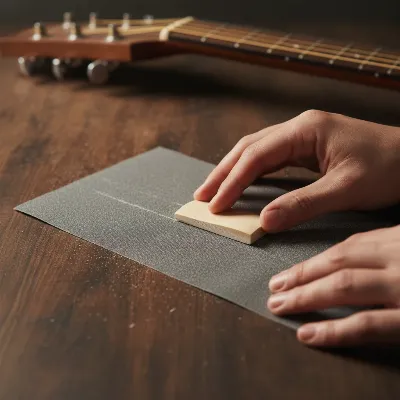 Hands carefully sanding an acoustic guitar saddle on a piece of sandpaper on a flat surface.
Step 4: Addressing Nut Height (If Necessary)
While less common for general action adjustments, a high nut can significantly impact playability in the first few frets. This adjustment is more delicate and often requires specialized tools.
The nut dictates the string height at the headstock end of the fretboard. If the strings are too high at the first fret, it can make chords like F major incredibly difficult and feel “stiff.” To check the nut height, fret a string at the 3rd fret and observe the clearance at the 1st fret. There should be a very slight gap, just enough for the string to clear the fret without buzzing when played open. If the strings sit too high, the nut slots need to be filed deeper. This requires specialized nut files, which match the gauge of your strings. Filing too deep can lead to severe open string buzzing and is difficult to reverse. For this reason, many players opt to have a professional luthier adjust the nut, especially if they are new to guitar maintenance. However, if you are confident and have the right tools, careful, incremental filing can resolve first-fret action issues.
Common Mistakes and Troubleshooting
Embarking on DIY guitar maintenance can be rewarding, but it’s easy to make common mistakes. Being aware of these pitfalls can help you avoid frustration and potential damage to your instrument.
One of the most frequent errors when adjusting action is sanding too much off the saddle in one go. It’s much easier to remove more material than to add it back. Always proceed in small increments, frequently rechecking the action. Another common issue is incorrect truss rod adjustment. Overtightening can damage the rod or neck, while insufficient adjustment won’t properly address neck relief. small turns and re-checking are key. If you experience fret buzz after adjustments, it could be due to several reasons: the action might be too low, the neck relief could be insufficient, or the nut slots might be too deep. Carefully re-evaluate each component. It’s also vital to distinguish between general high action and fret buzz. High action simply makes it hard to play; fret buzz indicates strings hitting frets unintentionally. Correctly diagnosing the problem before acting is crucial for effective troubleshooting.
“A well-set-up acoustic guitar feels like an extension of your body. Taking the time to understand and adjust its action is not just maintenance; it’s an investment in your musical journey and comfort.” – Alex Chen, Master Luthier
Maintenance Tips for Optimal Action
Achieving optimal action is not a one-time fix; it’s part of ongoing guitar care. Regular maintenance helps preserve your guitar’s playability and ensures its longevity.
Consistent cleaning of your guitar, especially the fretboard and bridge area, prevents dirt and grime buildup that can subtly affect action over time. Always use the appropriate string gauge for your guitar and playing style; switching to significantly heavier or lighter strings without re-evaluating your setup can alter neck tension and action. Perhaps the most critical, yet often overlooked, factor is humidity control. Acoustic guitars are highly susceptible to changes in humidity. Too dry, and the wood can shrink, causing fret sprout and a lower action. Too humid, and the wood can swell, leading to a higher action and potential intonation issues. Using a humidifier in dry environments and a dehumidifier in humid ones is essential to maintain the guitar’s structural integrity and stable action. Finally, know when to seek professional help. While DIY adjustments are empowering, complex issues like high frets, severe neck warps, or irreversible damage from incorrect adjustments warrant the expertise of a qualified luthier. They possess the specialized tools and knowledge to address intricate problems, ensuring your beloved instrument receives the best possible care.
Conclusion
Adjusting your acoustic guitar’s action can seem daunting, but it’s a fundamental skill that significantly enhances your playing experience. By understanding the roles of the truss rod, saddle, and nut, and by approaching each step with patience and precision, you can achieve a comfortable and responsive setup. This DIY journey not only empowers you with practical skills but also deepens your connection with your instrument, allowing you to unlock its full sonic potential. Don’t let high action hold you back from enjoying the beautiful sounds your acoustic guitar can produce. What subtle changes have you noticed in your playing after fine-tuning your guitar’s setup?

This guide was a game-changer for my old Martin D-18. I’ve always loved the tone, but the high action was really causing finger fatigue. Focusing on the saddle adjustment first, as suggested, really helped. The notes are clearer, and I can play for much longer without my hand cramping up. It truly unlocked the full potential of my guitar.
I’ve always been intimidated by adjusting my guitar’s action, but the guide on truss rod adjustments made it seem so much less daunting. My old dreadnought was a pain to play above the 7th fret, and now it feels like a completely different instrument. The playability is incredible, and my fingers aren’t nearly as tired after a long session. Highly recommend giving it a try if your guitar feels stiff.
I followed the steps for lowering the saddle on my Taylor, and it made a noticeable difference. The string height was definitely too high before, making barre chords a real struggle. Now it’s much more comfortable, and I’m not getting any buzzing. I was a bit nervous about sanding the saddle, but taking it slow really paid off. Just wish I’d done this sooner!
The information about optimal action being 2/32″ to 3/32″ at the 12th fret was super helpful for setting a target. I tried adjusting my cheap beginner guitar, and while it’s better, I still have some buzzing on the low E string. I think I might have gone a little too far with the saddle, or maybe my frets aren’t perfectly level. It’s an improvement, but not perfect.